
MATERIALS DECLARATION TEMPLATE
MATERIALS DECLARATION TEMPLATE
Information reserved for members
ONLINE FORM FOR A MATERIALS DECLARATION
Information reserved for members
An essential step in the context of CoP20 decisions
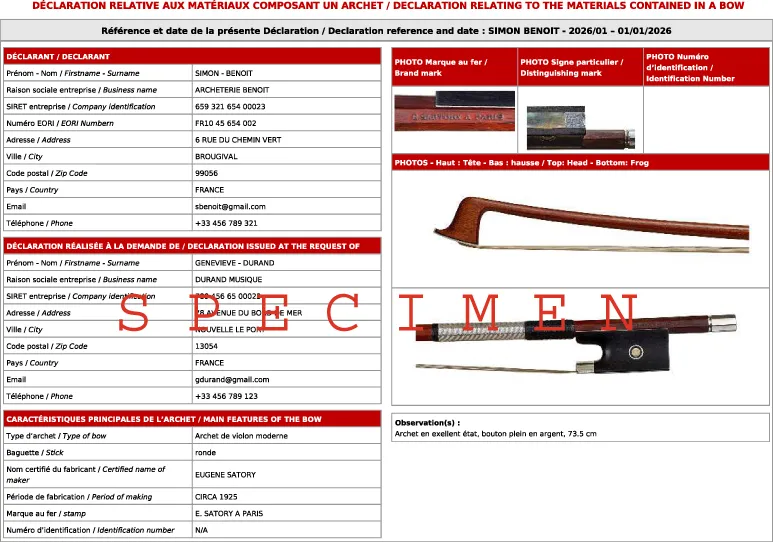
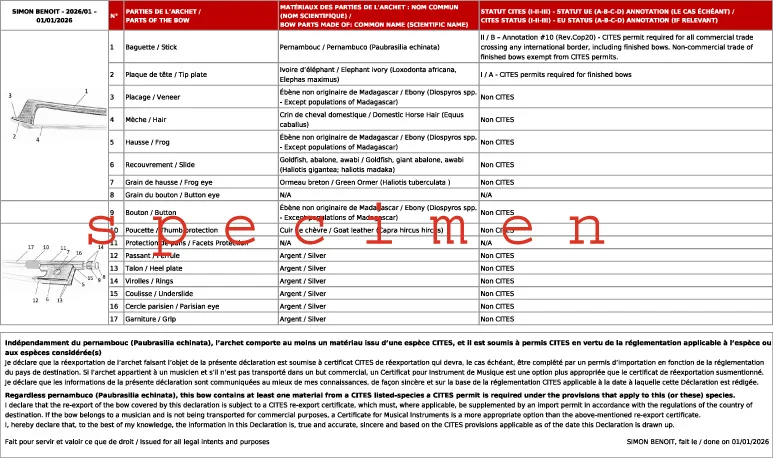
Modern and antique bows may contain materials derived from species listed in the appendices to the Convention on International Trade in Endangered Species of Wild Fauna and Flora (CITES). This is particularly the case for pernambuco wood (Paubrasilia echinata), but also for other species or materials of animal origin that may be regulated.
Following the decisions adopted at the 20th Conference of the Parties (CoP20), and in particular the new annotation #10 (Rev. CoP20), the distinction between commercial and non-commercial movements is now decisive for the cross-border movement of musical instruments and their accessories.
Why declare materials?
When a bow is not accompanied by a document detailing precisely the materials it is made of, its owner may find themselves in a situation of legal uncertainty, particularly:
* when crossing a border (sale, tour, competition, repair, appraisal, consignment);
* when applying for a CITES permit;
* during a customs inspection;
* in the context of a transfer or transmission.
The new annotation #10 (Rev. CoP20) specifies that eight categories of cross-border movements are considered non-commercial (paid or unpaid performances, personal use, exhibitions, loans, competitions, educational purposes, evaluation or repair, provided that this does not change ownership and that such transport is not intended for the sale, transfer or disposal of the specimen outside the owner's country of habitual residence).
In these situations, a CITES permit is not required, provided that the non-commercial nature of the movement can be demonstrated by the owner of the bow during any checks carried out at the border.
On the other hand, any border crossing involving the following constitutes a commercial movement:
* a sale,
* a purchase,
* a transfer for valuable consideration,
* a transfer free of charge (donation, transmission, inheritance),
* a consignment sale,
* any transfer of ownership,
* or any commercial purpose.
The fact that the transaction is free of charge does not therefore exclude its commercial nature within the meaning of CITES, since there is an international change of ownership.
These situations may require a CITES permit if the bow contains a material listed in the appendices.
A traceability tool that complies with international requirements
Even when a permit is not required (in the case of the eight non-commercial movements), it is strongly recommended that you accompany your bow with documents that:
1 - Prove the non-commercial nature of the border crossing
For example:
* tour contract,
* invitation to a festival or competition,
* registration certificate,
* repair voucher,
* sworn statement.
The aim is to remove any ambiguity during an inspection.
2 - Provide the required information on whether or not the materials are CITES-listed
A materials declaration allows you to:
* identify the species used;
* specify whether or not they are listed in the appendices;
* indicate, where applicable, the scope of the annotation;
* facilitate assessment by the authorities.
For commercial movements, this documentation becomes essential to support a permit application.
For non-commercial movements, it constitutes a preventive security measure.
Please note: the declaration does not replace a CITES permit!
The material declaration:
* does not constitute an exemption from the obligations of the Convention;
* does not replace a CITES permit when one is required;
* does not change the legal status of the specimen.
It is a technical document drawn up by a competent professional, intended to:
* clarify the composition of the bow;
* secure border crossings;
* support an administrative application, if necessary.
A responsible approach serving musicians and conservation
The aim is not to create an additional constraint, but to:
* anticipate difficulties at borders;
* prevent administrative blockages;
* demonstrate the non-commercial nature of travel where applicable;
* provide the necessary transparency on the status of materials.
In the context of the CoP20 decisions, traceability and documentary clarity have become essential elements in reconciling:
* species conservation,
* the free movement of musicians,
* and the legal security of bow owners.
MATERIALS DECLARATION TEMPLATE
Information reserved for members
ONLINE FORM FOR A MATERIALS DECLARATION
Information reserved for members
IPCI FRANCE EUROPE ASSOCIATION - 3 rue Truffaut 75017 Paris - Association number: W751269309


